
TL;DR

Get your wardrobe favorites delivered free with Prime
- Fast, free delivery on millions of items
- Prime Video, Amazon Music and more included
- Member-only deals all year
Prebuilt AI workstations save time and offer validated performance, while building gives control and customization. In 2026, costs and component shortages make the choice more nuanced than ever.
Build vs buy
an AI workstation.
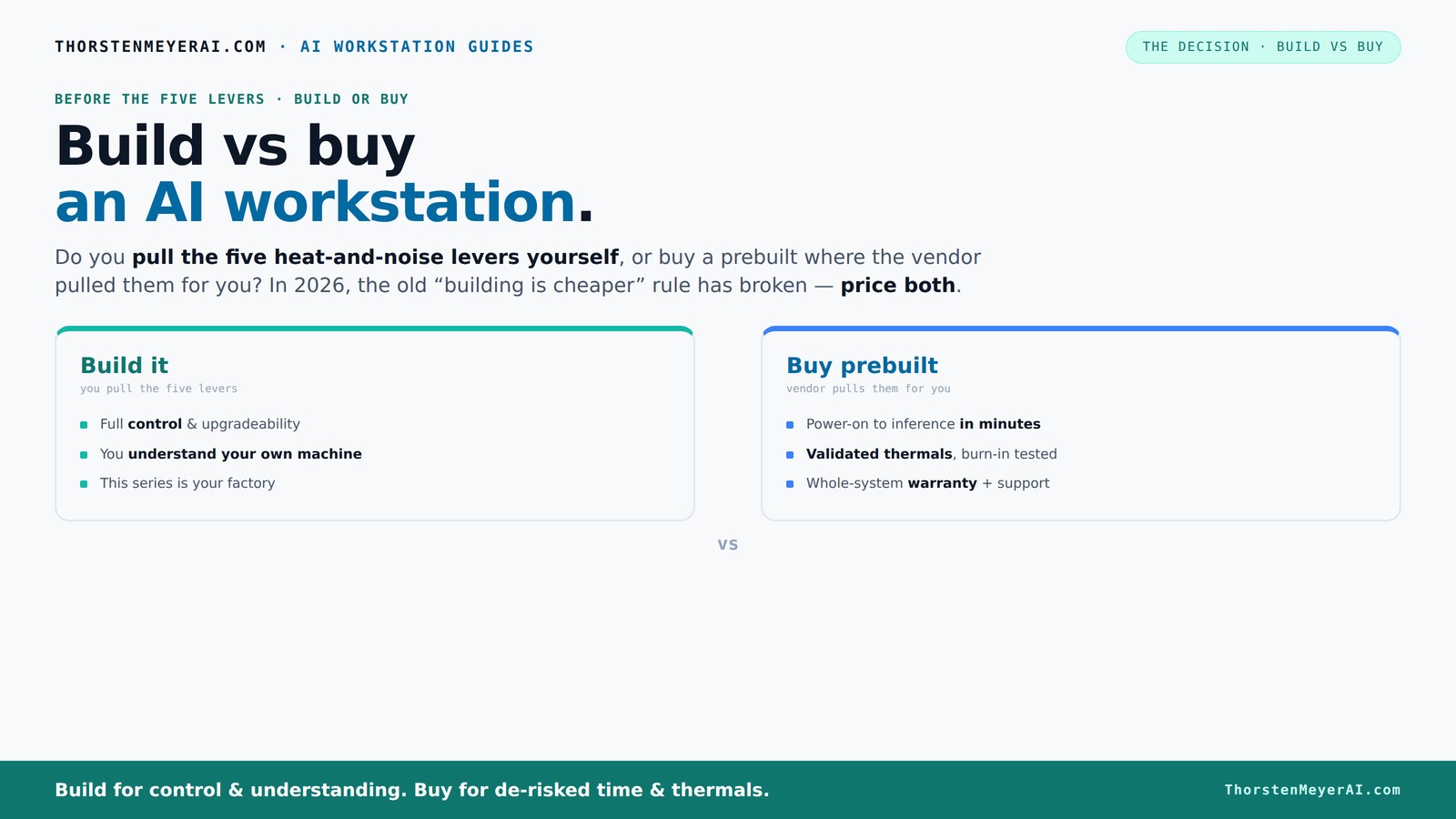
The real question behind this whole series: do you pull the five heat-and-noise levers yourself, or buy a prebuilt where the vendor pulled them for you? And in 2026, the old “building is cheaper” rule has broken. Match your situation in Part 3.
Key Takeaways
- Component shortages in 2026 make prebuilt AI workstations often as affordable as DIY builds, reversing the traditional cost advantage.
- Prebuilts save time with validated thermals, support, and ready-to-run AI software stacks, ideal for quick deployment.
- Building offers maximum control over hardware, cooling, and future upgrades, perfect for enthusiasts and long-term projects.
- In 2026, total value depends on workload, need for speed, and comfort with hardware fiddling—not just price.
- Always price both options for your specific configuration before making a final call, as market conditions fluctuate.
As an affiliate, we earn on qualifying purchases.
Why the old rule 'building is cheaper' no longer holds in 2026
In the past, building your own AI workstation was always the money saver. You picked parts, assembled, and saved big compared to prebuilt options. Not anymore. Supply chain issues have pushed component prices sky-high—DDR5 RAM, GPUs, SSDs, even motherboards.
For example, a DIY build that used to cost $1,000 can now easily top $1,250 or more. Meanwhile, prebuilt vendors, who buy in bulk, can offer systems at comparable or even lower prices because they’ve locked in deals before the shortages hit. The old rule—build cheaper—has cracked. Now, it’s about comparing total cost, considering the time you spend and the reliability you get.
**Why this matters:** When component prices soar, the typical assumption that DIY is always cheaper is invalid. If you’re saving money but spending hours troubleshooting compatibility, or risking hardware failures, the cost-effectiveness diminishes. Conversely, prebuilt systems often include warranties and support, which can save you time and money in the long run. The tradeoff shifts from initial component costs to overall value, reliability, and your own technical skills.
As an affiliate, we earn on qualifying purchases.
The five levers that make or break your AI workstation's heat and noise
Running a powerful AI rig isn’t just about the parts—it's about how you manage heat and sound. This comes down to five levers: undervolting the GPU, matching the cooler to your GPU, optimizing airflow, tuning fan curves, and positioning the machine.
If you build, you pull these levers yourself—choosing quiet GPUs, better coolers, or custom airflow setups. If you buy a prebuilt, the vendor handles this for you, often with rigorous testing and validation. Some companies, like Lambda, even offer water-cooling options that cut noise by up to 30% and keep temperatures rock-solid.
This focus on thermals and acoustics isn’t just luxury—it's essential for sustained workloads. Proper thermal management directly influences system stability, lifespan, and your productivity. Effective heat and noise management directly influence system stability, lifespan, and your productivity. A system that runs hot or loud can throttle performance, cause hardware degradation over time, and create an uncomfortable workspace. Prebuilt systems arrive tuned for optimal thermal and acoustic performance, reducing the need for trial-and-error adjustments, which can be costly and time-consuming. This is especially critical when running intensive training sessions or long inference jobs, where thermal throttling can significantly impact results.
As an affiliate, we earn on qualifying purchases.
What you get with a prebuilt AI workstation (and what you miss)
Prebuilt systems come with plug-and-play convenience, often with warranty and support included. They arrive with the OS, drivers, and AI frameworks like CUDA, TensorFlow, and Docker already installed. You power on, and your machine is ready for inference or training.
Plus, you benefit from validated thermals, robust support, and warranties—sometimes up to 5 years of support from vendors like Puget or Lambda. They run extensive burn-in tests, ensuring your system won’t throttle under heavy loads. This reduces setup time and the risk of hardware failures mid-project.
**Why this matters:** These validations and support arrangements are crucial for professionals who need reliable, consistent performance without the hassle of troubleshooting hardware issues. When you buy prebuilt, you’re paying for peace of mind—knowing that your system has been tested to operate under demanding AI workloads, which can be unpredictable and resource-intensive. However, you lose some flexibility: you can’t always choose every component, and upgrading might be limited or complicated, especially if the vendor uses proprietary parts or sealed units. For long-term projects or specific hardware needs, this tradeoff can impact your scalability and customization options.
As an affiliate, we earn on qualifying purchases.
When building your own AI workstation makes sense (and when it doesn’t)
Building shines when you want tailored hardware, control over every component, or to squeeze the last dollar out of your budget. Learn more about build vs buy options. Hobbyists, students, and professionals who love tinkering can fine-tune their GPU, RAM, and cooling setup to match their workload exactly.
For example, you might undervolt a GPU for quieter operation or choose a specific cooler to reduce noise during long runs. This gives you the flexibility to optimize for power efficiency or thermal performance in ways a prebuilt can’t match.
**Why it matters:** Custom builds allow you to prioritize specific features—like ultra-quiet operation, maximum overclocking, or energy efficiency—tailored precisely to your workflow. This level of control can lead to better performance-per-watt, longer hardware lifespan, and a more satisfying tinkering experience. However, this comes with tradeoffs: building requires technical skills, time investment, and ongoing maintenance. Compatibility issues, BIOS configuration, and troubleshooting can become significant hurdles, especially for complex multi-GPU setups. If your workload is straightforward or you need rapid deployment, these challenges might outweigh the benefits.
Compare the costs: build vs buy in 2026
| Factor | Build Your Own | Buy Prebuilt |
|---|---|---|
| Cost | Often $1,250+ for high-end parts due to shortages | Comparable or lower prices thanks to bulk buying |
| Time to deploy | Multiple hours to days—assembly, testing, software setup | Minutes—power on and go |
| Customization | Full control over GPU, RAM, cooling, case | Limited to vendor options |
| Support/Warranty | Individual warranties, troubleshooting required | Vendor support, warranty included |
| Thermal & Noise Optimization | DIY tuning required | Factory validated, less effort |
In 2026, the cost gap narrows, but the decision still hinges on your priorities. If you value customization, upgradeability, and a learning experience, building may be worth the extra effort. If you need a reliable, ready-to-use system with minimal fuss, prebuilt options often provide better overall value. Always compare the total cost and features for your specific configuration before deciding, as market fluctuations can tip the balance.
Upgradeability and future-proofing: which is better?
If you want a machine you can grow with, building often wins. You can choose a motherboard with extra PCIe slots, larger PSU, and more RAM capacity, making future upgrades easier.
Prebuilt systems vary. Some are designed with upgrade paths, but others are sealed units. Check the vendor’s specs carefully. For example, a DIY build might start with a 750W PSU and leave room for a second GPU later, while a prebuilt might have all slots filled or limited PSU capacity.
**Why it matters:** Your long-term flexibility depends on the initial design choices. Building your own system allows you to plan for future expansions—adding more RAM, upgrading GPUs, or increasing storage—without replacing the entire machine. Prebuilt systems, especially sealed or proprietary designs, can limit these options, potentially requiring costly replacements down the line. If your workload is expected to grow or evolve, choosing a build with upgrade paths can save time and money in the future, ensuring your investment remains relevant and capable as demands increase.
The final call: speed, support, or control?
Ultimately, your choice boils down to your priorities. Need a system fast, with minimal fuss? A prebuilt is your best bet. Want full control, customization, and a learning experience? Building is the way to go.
In 2026, the lines blur—costs, component shortages, and AI software ecosystems all influence your decision. Consider your workload, budget, and patience before choosing. Remember: sometimes, the fastest route isn’t the cheapest or the easiest.
Frequently Asked Questions
Is it cheaper to build or buy a prebuilt AI workstation?
In 2026, component shortages and bulk buying have closed the price gap. Always compare prices for your specific setup, but prebuilts can often match or beat DIY costs thanks to vendor discounts.Which option offers better performance for AI workloads?
Performance depends on the quality of components. Prebuilts from reputable vendors validate thermal and power delivery, ensuring consistent performance. DIY allows custom tuning but requires more effort.Do prebuilts use lower-quality parts?
Not necessarily. Reputable vendors use high-quality parts, but some lower-end models may cut corners on cooling or power. Always research the specific system and read reviews.How important is the GPU compared to CPU, RAM, and cooling?
For AI workloads, GPU performance and thermal management are critical. A well-cooled GPU can sustain higher loads longer, directly impacting training and inference speeds.Can I upgrade a prebuilt AI workstation later?
It depends. Some prebuilts are designed with upgrade paths, but others are sealed units. Check the vendor’s specs before purchase if future expansion matters.Conclusion
Choosing between build and buy isn’t just about saving a few dollars anymore. It’s about what matters most—speed, support, or control. In this wild market, making a clear-eyed decision can save time, money, and frustration. Your ideal workstation is the one that fits your workflow, not just your budget.Fall Picks
fall essentials
As an affiliate, we earn on qualifying purchases.